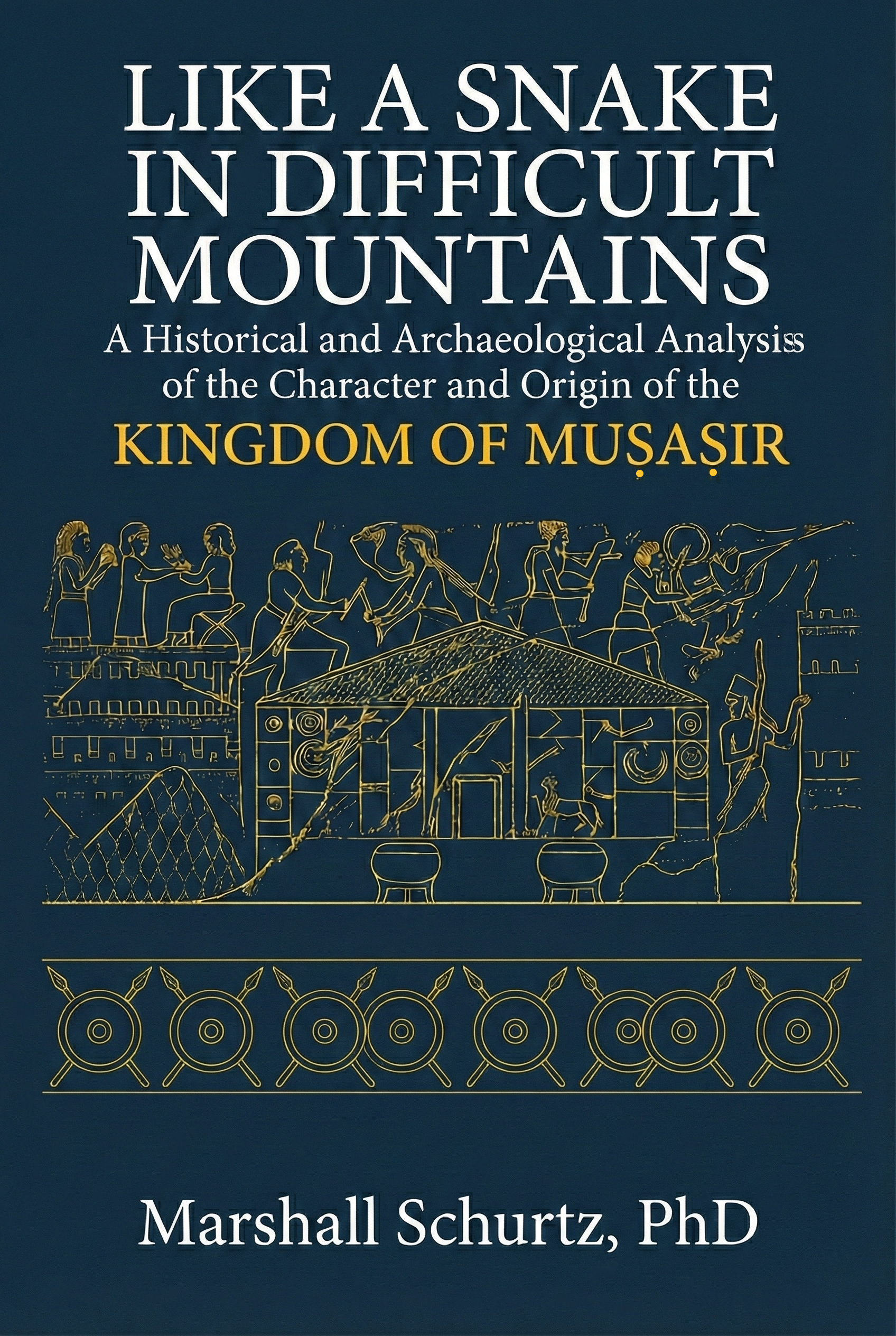
DOCTORAL DISSERTATION • 2022
"Like a Snake in Difficult Mountains": A Historical and Archaeological Analysis of the Character and Origin of the Iron Age Kingdom of Muṣaṣir
Marshall Wheeler Schurtz
Doctor of Philosophy, University of Pennsylvania
Dissertation Advisor: Richard L. Zettler
Abstract
Small polities of marginal borderland regions in the Near East were often pushed and pulled by their far larger neighbors' political and economic spheres, forced to adapt to their social and environmental situation to thrive and maintain independence. ...
Small polities of marginal borderland regions in the Near East were often pushed and pulled by their far larger neighbors' political and economic spheres, forced to adapt to their social and environmental situation to thrive and maintain independence. The kingdom of Muṣaṣir, the home to the chief Urartian deity, Ḫaldi, lay in one of these frontier zones in the rugged mountains of northeast Iraq. Despite the significance of the kingdom's temple for the Urartian kings' religious ideology, the steep peaks and narrow flatlands of Muṣaṣir's environs were ill-suited to substantial occupation.
In order to locate Muṣaṣir and better understand the settlement behaviors of ancient occupation in the Sidekan subdistrict of Erbil, Iraq, the Rowanduz Archaeological Program (RAP) commenced a series of excavations and a survey in 2013. Excavation of the rural homestead of Gund-i Topzawa provided a dataset to investigate the reasons for settlement in this marginal environment. Synchronizing archaeological data to the Middle Iron Age (1050-550 BCE) Neo-Assyrian campaign texts and illustrations led to broader research questions exploring the factors driving the region's chronologically limited sedentary occupation and the impact coopting a religious system has on the local polity and its appropriators.
This study publishes the ceramic typology, stratigraphic, and architectural findings from the excavations of Gund-i Topzawa and Sidekan Bank, as well as the collected pottery and occupation qualities of surveyed sites in the Sidekan subdistrict (2014-2016). The pottery sequence, structural characteristics, and settlement patterns added to the understanding of the chronological sequence of the northern Zagros Mountains and further confirmed the locational specificity of Muṣaṣir with the Ḫaldi temple's likely location at Mudjesir. Modeling the Iron Age populace's ecological adaptations to environmental, social, and political stimuli indicate the interaction of cultural and technology factors first spurred Sidekan's sedentary occupation in the Late Bronze Age, and the later cooption of Ḫaldi by the Urartian kings led to the area's subsequent stagnation and contraction as the god's appropriators declined.
Read Online
The complete dissertation is available to read online. Select a chapter below to begin.
Introduction & Geographical Background
An introduction to the kingdom of Muṣaṣir and the geographical context of the Sidekan subdistrict in northeast Iraq's rugged Zagros Mountains.
Read Full Chapter →Historical Background of Sidekan
A comprehensive historical overview spanning from the Early Bronze Age through the Ottoman period, including the kingdoms of Simurrum, Turukku, Kakmum, and the major powers of Assyria and Urartu.
Read Full Chapter →Archaeological Background of Sidekan and Soran
Review of previous archaeological work in the region and context for the Rowanduz Archaeological Program (RAP) excavations and survey.
Read Full Chapter →Excavations of Gund-i Topzawa, Ghaberstan-i Topzawa, Sidekan Bank
Detailed publication of excavation findings from three sites, including ceramic typology, stratigraphy, and architectural remains.
Read Full Chapter →Survey of the Sidekan Subdistrict
Results from the systematic archaeological survey (2014-2016), documenting pottery and occupation patterns across the landscape.
Read Full Chapter →The Landscape and Settlement Patterns of the Sidekan Subdistrict
Analysis of ecological adaptations and settlement behaviors, modeling environmental, social, and political factors.
Read Full Chapter →Conclusion - The Character and Origin of Muṣaṣir
Synthesis confirming Muṣaṣir's location and examining how appropriation of the Ḫaldi cult by Urartian kings affected settlement dynamics.
Read Full Chapter →ABOUT THIS RESEARCH
This dissertation was conducted as part of the Rowanduz Archaeological Program (RAP), which conducted excavations and survey work in the Sidekan subdistrict of Erbil, Iraq from 2013-2016.
The research contributes to understanding of Iron Age settlement patterns in the northern Zagros Mountains and helps confirm the location of the ancient kingdom of Muṣaṣir, home to the temple of Ḫaldi, the chief deity of the Urartian kingdom.
Cite This Work
Schurtz, Marshall W. (2022). "Like a Snake in Difficult Mountains": A Historical and Archaeological Analysis of the Character and Origin of the Iron Age Kingdom of Muṣaṣir (Doctoral dissertation). University of Pennsylvania, Philadelphia, PA.
Prefer a PDF?
DOWNLOAD FULL PDF